"Global Possibilities"

Committed to educating the public about solutions to our ecological, economic and political crises.

  • Home
  • About Us
    • Bios
    • Educational Archives
      • Donald W. Aitken Keynote Presentation
    • Links
  • Film & Video
    • “Who’s Got The Power?”
    • Video
  • Casey Coates Danson
    • Design Projects
    • Casey Coates Danson Bio
  • Angels Unawares
    • US Homeless Sleeping Accommodation Directory
  • Topics
    • Activism
    • Architecture
    • Climate Change
    • Conferences
    • Design
    • Economy
    • Energy
    • Environment
    • Food
    • Fracking
    • Health
    • Media
    • News
    • Oceans
    • Politics
    • Sustainability
    • How To Be Green
    • Visionaries
    • Water
  • Contact Us
Home » Energy » Sorry, but you’ve got a gas emissions problem

Sorry, but you’ve got a gas emissions problem

Jan 28, 2019 by GlobalPossibilities

[Translate]

Grist


GASSY
By Nathanael Johnson on Jan 28, 2019
Get your daily dose of good newsfrom Grist Subscribe to The Beacon

The burgeoning love affair between Americans and renewable energy is turning into a love triangle with natural gas.

That’s one of the findings from the U.S. Energy Information Administration recently released annual forecast. The projections, widely used by bureaucrats and business people, show renewables and gas becoming the main source of our electricity and sales of gasoline-burning cars declining. But greenhouse gas emissions aren’t expected to fall much. What gives?

One reason: Even though coal emissions are falling, emissions from natural gas are making up the difference. And the country keeps using more energy. Last year for instance, according to another recent EIA report, U.S. emissions ticked up as more Americans turned up their air conditioners and heaters to stay comfortable in extreme weather.

EIA

It’s an open question whether things will play out this way, of course. The EIA’s predictions have consistently underestimated the growth of renewable energy (more on the caveats below). In 2009, for instance, the EIA expected wind and solar to take 20 years to reach 56 gigawatts of capacity. Instead, thanks to a suite of new policies from President Barack Obama’s administration, the U.S. built 89 GW in just six years. As Mike Grunwald from Politico put it, “Oops.”

Still, this particular crystal ball provides a solid estimate of the country’s current trajectory, because its forecasts are built on recent trends. A quick perusal of the following charts will give you a sense of how much climate progress the country is making.

First, the good news. Renewable energy is poised to grow so robustly that it would easily exceeds states’ carbon-cutting goals.

For the foreseeable future, the United States will be turning to solar panels, wind turbines, and gas plants to generate electricity, according to the forecast, while shuttering nuclear, oil, and coal plants.

All this points to renewables and natural gas pairing up to provide most of our electricity. That makes some sense, because renewables play well with gas. Gas plants are easy to control — they can ramp up and down cheaply. And renewables depend on nature (the rising sun and the gusting wind) so need a partner to fill in the gaps.

Electricity is just one slice of our oh-so-yummy energy pie. But that slice should grow as more people begin to buy electric cars. The EIA projects that cars with internal combustion engines will lose market share in the coming years. But it expects that decline to level off shortly after 2020.

EIA

When you look at the other sources of energy demand, like industry and buildings, the EIA sees something similar happening: Emissions are flat, or slowly falling.

Add it all up and you get per-person emissions declining, but declining pretty darn slowly. Even if oil prices spike, the EIA expects just a 25 percent decline in per-capita emissions by 2050.

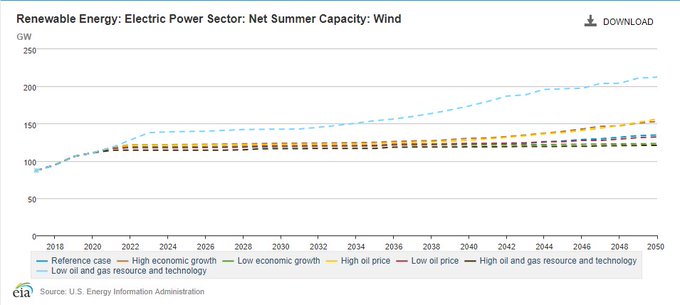
There are caveats here. The energy analyst Alex Gilbert, co-founder of the energy-research company SparkLibrary, thinks it’s also unrealistic to expect coal to pull out of its death spiral (the EIA sees that plunge mellowing into a glide), and points out that EIA is predicting that folks will pretty much stop building wind turbines, which seems… unlikely.


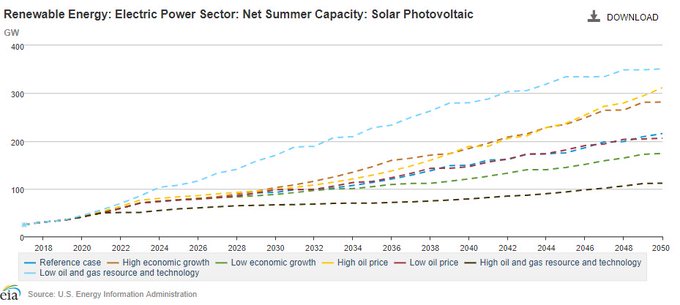
In AEO 2019, this is…. much improved for solar. Utility-scale capacity and generation across scenarios is 5-10 times higher than 2018 levels. While I’d argue these may still be a bit on the low side (assuming no climate constraint), they are reasonable
View image on Twitter

Wind, however, is projected to die an early and industry-shattering death. In only 1 scenario does wind capacity see any growth post 2020. EIA also projects 0 MW of off-shore wind. Both of these projections are in significant conflict with industry expectations pic.twitter.com/yGOcg74bqI
View image on Twitter
What’s more, the EIA’s expectations for a shift away from gas-powered cars lag far behind estimates by others. The EIA has also consistently underestimated the growth of renewable energy, and it may do the same with the growth of electric vehicles.

Related Posts

  • Maine’s heat pump boom has been promising for rural workforce development. Can it last?

    Posted on Aug 3, 2025

  • Sonoma-Mendocino geothermal energy project

    Posted on Aug 3, 2025

  • Feds deny permits for controversial project on Black Mesa

    Posted on Feb 16, 2025

  • Putin’s war and global energy

    Posted on Apr 4, 2022

Tags

  • EIA
  • Electric Vehicles
  • Energy
  • Energy Information Administration
  • Natural Gas
  • Renewable Energy

Share This

Leave a Reply Cancel reply

Your email address will not be published. Required fields are marked *

Subscribe to receive new blogposts


Contact Us!

Donate to Global Possibilities

Recent Posts

  • Mystery of dancing spiders’ DNA could explain how they develop into new species

Purchase – ANGELS UNAWARES

Angels Unawares Awarded Outstanding Book of the Year – Most Original Concept for 2019 by Independent Publisher Book Awards!

Image result for independent publishing awards

Archives

  • September 2025
  • August 2025
  • July 2025
  • June 2025
  • May 2025
  • April 2025
  • March 2025
  • February 2025
  • September 2022
  • August 2022
  • July 2022
  • June 2022
  • May 2022
  • April 2022
  • February 2022
  • January 2022
  • December 2021
  • November 2021
  • October 2021
  • September 2021
  • August 2021
  • July 2021
  • June 2021
  • May 2021
  • April 2021
  • March 2021
  • February 2021
  • January 2021
  • December 2020
  • October 2020
  • September 2020
  • August 2020
  • July 2020
  • June 2020
  • May 2020
  • April 2020
  • March 2020
  • February 2020
  • January 2020
  • December 2019
  • November 2019
  • October 2019
  • September 2019
  • August 2019
  • July 2019
  • June 2019
  • May 2019
  • April 2019
  • March 2019
  • February 2019
  • January 2019
  • December 2018
  • November 2018
  • October 2018
  • September 2018
  • August 2018
  • July 2018
  • June 2018
  • May 2018
  • April 2018
  • March 2018
  • February 2018
  • January 2018
  • December 2017
  • November 2017
  • October 2017
  • September 2017
  • August 2017
  • July 2017
  • June 2017
  • May 2017
  • April 2017
  • March 2017
  • February 2017
  • January 2017
  • December 2016
  • November 2016
  • October 2016
  • September 2016
  • August 2016
  • July 2016
  • June 2016
  • May 2016
  • April 2016
  • March 2016
  • February 2016
  • January 2016
  • December 2015
  • November 2015
  • October 2015
  • September 2015
  • August 2015
  • July 2015
  • June 2015
  • May 2015
  • April 2015
  • March 2015
  • February 2015
  • January 2015

Donate to Global Possibilities

Follow Us!

Follow Us on FacebookFollow Us on TwitterFollow Us on LinkedIn

Adsense

google.com, pub-2848125826401092, DIRECT, f08c47fec0942fa0

Designed by Elegant Themes | Powered by WordPress

العربية العربية česky česky dansk dansk Deutsch Deutsch español español فارسی فارسی français français עברית עברית हिन्दी हिन्दी italiano italiano 日本語 日本語 한국어 한국어 Nederlands Nederlands norsk norsk polski polski português português русский русский svenska svenska ภาษาไทย ภาษาไทย tiếng Việt tiếng Việt ייִדיש ייִדיש 中文 (简体) 中文 (简体) 中文 (繁體) 中文 (繁體) powered byGoogle